
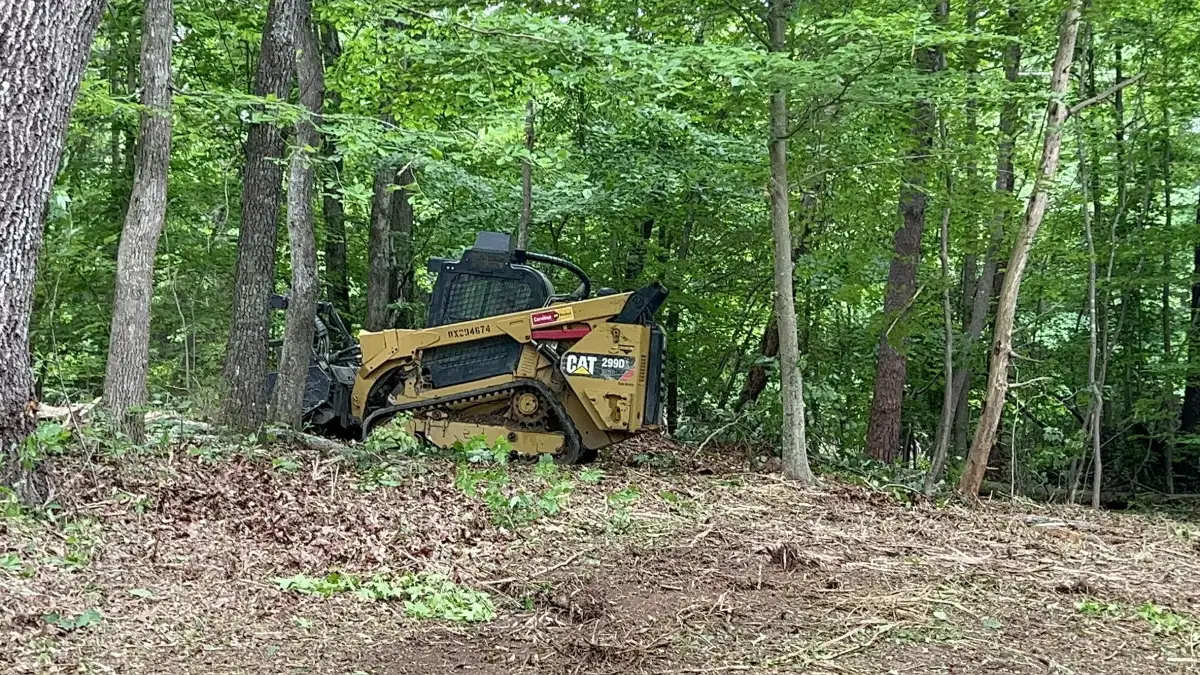
A land grading estimate should answer a bigger question than “How much soil will be moved?” It should explain what is causing the problem, where runoff will travel after the ground is reshaped, and what condition the surface will be left in. Those details determine whether two quotes actually describe the same job.
This is especially important when comparing land grading and drainage work in Winston-Salem. Rolling ground can carry water well beyond the place where a puddle forms, and Piedmont clay behaves differently when it is saturated, workable, or very dry. The questions below help homeowners define the outcome before choosing a scope.
1. What Problem Is the Grading Supposed to Solve?
Standing water, erosion, rough ground, failed turf, and preparation for a patio or new lawn can all lead a homeowner to request grading, but they are not the same project. A low spot may be where water collects rather than where the trouble begins. Runoff may enter from a downspout, a higher part of the property, a compacted path, or an adjoining hard surface.
When it is safe, observe one rain event from beginning to end. Note where water first appears, which direction it moves, whether it carries soil, and how long the lowest areas stay wet after nearby ground begins to dry. Photos taken during the event can show conditions that disappear by estimate day. You do not need to diagnose the yard; you are giving the contractor a better record of the symptom.
2. Where Will the Water Go After the Grade Changes?
Moving water away from one spot is only part of the answer. The new route also needs to account for structures, walkways, driveways, beds, neighboring grades, and a suitable outlet. Ask the estimator to trace that route in plain language—from the source, across the work area, to the place runoff is expected to leave or disperse.
Grading changes the shape of the surface. A drainage component collects or carries water at a specific point. Depending on the source and the available outlet, the proposed work may involve reshaping the ground, a swale, inlet, pipe, downspout adjustment, or a coordinated combination. If the project is tied to development, redevelopment, or regulated stormwater infrastructure, the City of Winston-Salem provides information about its post-construction stormwater program.
3. What Exactly Is Included in the Written Scope?
A total price is difficult to evaluate without defined work limits. The proposal should make clear which area will be disturbed, how equipment will reach it, what material will be added or removed, which drainage tasks are included, and how the ground will be stabilized or restored. Ask whether the finish includes topsoil, seed, sod, mulch, gravel, or preparation for a later hardscape.
This is where seemingly similar bids often separate. One may cover rough earthwork only, while another includes finish grading and lawn restoration. Compare each line by the intended outcome—not by the lowest number at the bottom. For more detail on the variables behind an estimate, read the guide to land grading costs and scope in North Carolina.
4. What Property Access or Site Features Affect the Work?
Equipment access can change the practical scope. A wide, open approach allows different options than a narrow gate, steep side yard, soft route, or work area behind established landscaping. Ask what equipment is expected, where it will enter, and whether fences, turf, paving, or planting along the access route need protection or temporary removal.
Before work begins, identify irrigation, landscape lighting wire, invisible fencing, septic components, private drainage lines, and other site features. Public utility markings may not locate privately installed systems. Also tell the estimator what will be built or planted next so finished elevations can meet those edges. For a larger construction sequence, the grading and site preparation service explains how the intended final use shapes the earthwork.
5. How Do Soil Moisture and Timing Affect the Schedule?
There is no single best month for every Winston-Salem yard. A workable moisture window and the next planned surface matter more than a calendar rule. Saturated clay can rut or smear under equipment; very dry clay can be difficult to cut and shape. Heavy rain may require the area to dry before equipment can work without causing avoidable damage.
The schedule should also account for what follows. A grade that will receive new sod needs a coordinated finish and a clear watering plan. Seed, planting, gravel, and hardscaping have different preparation and timing needs. Ask whether the proposal covers that transition or ends before the final surface is installed.
6. What Determines the Cost of Yard Regrading?
Square footage alone does not predict price. The estimate can change with the amount and depth of soil movement, slope, access, soil moisture, imported fill or topsoil, excess-material removal, drainage components, erosion control, and restoration. A smaller side yard with restricted access may require more handling than a larger open area.
Online averages cannot show those site conditions. The most useful comparison is between written scopes that cover the same limits, materials, and finish. If one price is substantially lower, ask what is excluded and whether the proposed correction follows the entire water path.
7. What Is the Least-Cost Approach That Still Solves the Problem?
The cheapest responsible option is not automatically the most soil movement or the fewest drainage parts. It is the smallest complete scope that addresses the actual cause, protects the outlet, and leaves a stable surface. Adding soil only at the visible puddle may be inexpensive, but it can fail if runoff continues to arrive from higher ground or simply shifts into a new low spot.
Ask the estimator which parts are necessary now, which are finish choices, and whether any work can be coordinated with planned sod, planting, or hardscaping to avoid disturbing the same area twice. A phased plan can be reasonable when each phase has a clear, functional endpoint.
8. What Should I Watch After the Work Is Finished?
Disturbed soil needs protection while the planned cover becomes established. Confirm who is responsible for watering, limiting traffic, replacing washed material, and checking the area after rain. If sod or seed is included, ask for the handoff point and the homeowner’s early-care responsibilities.
During a normal rain, watch the complete route rather than only the original puddle. Look for runoff moving toward a structure, crossing a walkway, cutting a new channel, or carrying soil from an unfinished area. Photos taken while the issue is happening are useful if the scope needs to be reviewed.
Booking Checklist for a Winston-Salem Grading Estimate
- Record where water starts, travels, collects, and exits during rain.
- Define how the finished area needs to function.
- Identify access limits and private site features before equipment arrives.
- Compare the same work limits, materials, drainage tasks, and finish.
- Coordinate grading with sod, seed, planting, or construction that follows.
- Confirm stabilization, aftercare, and what to observe after completion.
Request a Land Grading Estimate in Winston-Salem
Webber Landscaping and Outdoor Solutions provides land grading in Winston-Salem and across the Piedmont Triad. Share what happens during rain, where the work area can be accessed, and what the finished surface needs to support. Contact Webber Landscaping to request an estimate, or call (336) 770-2385.